


Many software teams have adopted the Agile software development process because it helps them to deliver value sooner, learn from feedback, and adapt as requirements evolve. Rather than following a single, linear plan, Agile emphasizes iterative and incremental delivery: teams build small slices of working software, review results with stakeholders, and adjust course. By prioritizing collaboration, transparency, and continuous improvement, Agile teams can respond to change without sacrificing quality.
This article provides a practical overview of the process and compares it with DevOps and the Waterfall methodology so you can see where each approach fits best.
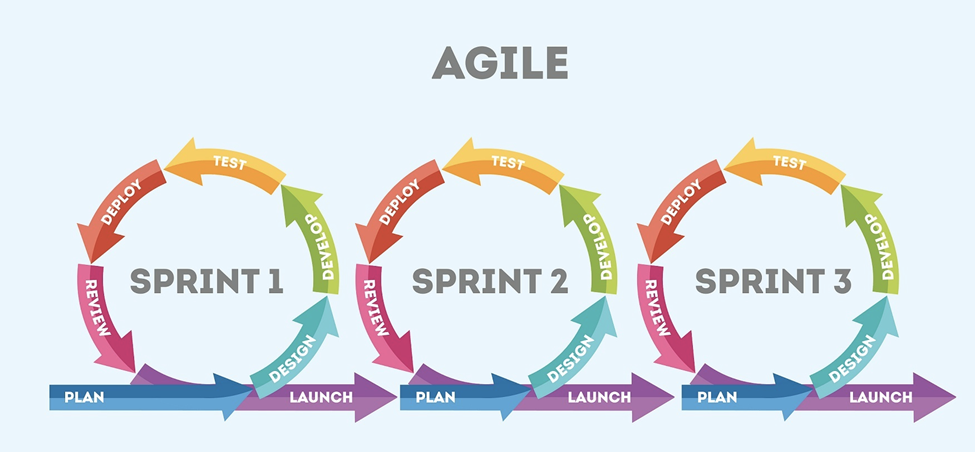
What is Agile software development?
Agile software development is an umbrella term for a set of methods and practices that emphasize collaboration, fast feedback, and continuous improvement. Agile teams are typically cross-functional and empowered to make day-to-day decisions so they can deliver working software in small increments.
One common Agile pattern is timeboxed iterations (often called “sprints”), where a team selects a small set of work, builds it, and produces a potentially shippable increment by the end of the iteration. Other Agile approaches such as Kanban focus on continuous flow, rather than timeboxes, but the goal is similar: deliver value frequently, inspect results, and adapt.
Agile also relies on close collaboration and frequent communication among developers, testers, designers, product people and stakeholders. The aim is to share context early, surface risks quickly, and produce the simplest solution that meets the need – then refine it based upon real feedback.
What happens in the Agile development lifecycle?
In an Agile lifecycle, responsibilities are shared across the team, but different people often focus on different aspects of the work. Common responsibilities include:
- Gathering and defining requirements – working with stakeholders to understand outcomes, clarify acceptance criteria, and maintain a prioritized backlog of work.
- Developing the software – designing, implementing, testing and integrating changes so the product increment is potentially releasable.
- Managing the work – planning and coordinating day-to-day delivery (e.g., Sprint planning or flow management), tracking progress, and removing impediments.
- Communicating with stakeholders – keeping stakeholders informed, demonstrating progress frequently, and incorporating feedback into the backlog.
- Continuous improvement – regularly inspecting the process and product, then making incremental improvements (technical and organizational).
What are the principles of the Agile Manifesto?
The Agile Manifesto defines four values and 12 principles that guide Agile ways of working. The four values are:
1) Individuals and interactions over processes and tools
2) Working software over comprehensive documentation
3) Customer collaboration over contract negotiation
4) Responding to change over following a plan
The 12 principles expand upon these values:
- Satisfy through early and continuous delivery of valuable software.
- Welcome change requirements, even late in development, to provide the customer a competitive advantage.
- Deliver working software frequently, from a couple of weeks to a couple of months, with a preference for the shorter timescale.
- Business people and developers work together daily throughout the project.
- Build projects around motivated individuals; give them the environment and support they need, and trust them to get the job done.
- The most efficient and effective method of conveying information to and within a development team is face-to-face conversation.
- Working software is the primary measure of progress.
- Agile processes promote sustainable development; sponsors, developers, and users should be able to maintain a constant pace indefinitely.
- Continuous attention to technical excellence and good design enhances agility.
- Simplicity – the art of maximizing the amount of work not done – is essential.
- The best architectures, requirements, and designs emerge from self-organizing teams.
- At regular intervals, the team reflects on how to become more effective, then tunes and adjusts its behavior accordingly.
Together, these values and principles emphasize delivering working software early, collaborating closely with customers and stakeholders, and continuously improving both the product and the process.
Agile software development framework explained
A specific method or framework for developing software that puts Agile values into practice is often called an Agile framework (or method).
These frameworks can be thought of as starting points. The Manifesto reminds us that “individuals and interactions over processes and tools” is the priority, so teams should adapt any framework to fit their context.
Organizations often blend practices from multiple frameworks and refine them over time. Below are brief overviews of several widely used Agile frameworks including Scrum, Kanban, Extreme Programming (XP), Lean Software Development (LSD), and Crystal.
What is Scrum?
Scrum is a lightweight framework for tackling complex work through short, timeboxed iterations called Sprints. It is one of the most widely adopted Agile frameworks and is defined in the Scrum Guide.
Scrum provides enough structure to help teams get started (accountabilities, events, and artifacts) while still encouraging teams to inspect and adapt. Common Scrum elements include:
- A self-managing cross-functional Scrum Team accountable for delivering a valuable Increment each Sprint.
- A Product Owner who manages the Product Backlog and maximizes product value.
- A Scrum Master who coaches the team and organization in Scrum and helps remove impediments.
- Five events (Sprint, Sprint Planning, Daily Scrum, Sprint Review, Sprint Retrospective) that create regular feedback loops.
- Three artifacts (Product Backlog, Sprint Backlog, and Increment) and transparency through a shared Definition of Done.
What is Kanban?
Kanban is a method for managing and improving the flow of work. Many Agile and DevOps teams use Kanban practices to visualize workflow, limit work in progress, and improve predictability.
Some of the key Kanban practices include the following:
- Visualize the workflow (often with a board) so everyone can see the state of work.
- Limit work in progress (WIP) to reduce multitasking and improve flow.
- Manage flow using explicit policies (for example, definitions of “done”) and flow metrics such as lead time cycle time.
- Use feedback loops / cadences (for example, replenishment and delivery reviews) to review progress and improve continuously.
What is Extreme Programming (XP)?
Extreme Programming (XP) is an Agile approach focused upon engineering practices that improve code quality and responsiveness to change, especially in environments with evolving requirements.
Reasons for adopting this method include:
- When requirements change frequently or are initially uncertain.
- When projects have tight deadlines, significant technical risk, or a need for high quality.
- When teams are small-to-medium sized and can collaborate closely (co-located or highly communicative).
- When automated unit, integration, and functional tests are feasible and valued.
And some of its advantages include:
- Short iterations and small releases get feedback quickly.
- The use of test-driven development (TDD) and continuous integration to maintain a releasable codebase.
- Users can pair programming and collective ownership to spread knowledge and improve quality.
- Refactoring and XP’s simple design keeps the codebase clean as it evolves.
- XP receives frequent customer feedback to support long-term delivery.
What is Lean Software Development?
Lean Software Development (LSD) adapts ‘Lean’ thinking to software: focus on value, reduce waste, and optimize the whole system from idea to delivery. Teams often pair Lean with techniques such as Minimum Viable Product (MVP) experiments to validate assumptions quickly. MVP is not a synonym for Lean, but it aligns with Lean’s emphasis on rapid learning and avoiding unnecessary work.
The Minimum Viable Product (MVP) strategy, which is another name for the Lean methodology, involves a team releasing the barebones version of their product to the market, finding out from consumers what they like, dislike, and want to be included, and then iterating based on this input.
These are the seven Lean principles:
- Eliminate waste
- Build quality
- Create knowledge
- Defer commitment
- Deliver fast
- Respect people
- Optimize the whole
What is Crystal?
Crystal is a family of Agile methods that emphasizes people, interaction, and tailoring the process to the team size and the criticality of work. Because Crystal is intentionally adaptable, teams choose only the amount of process needed and adjust it as the project evolves.
This flexibility can work well for organizations that want to empower teams to decide how they work best, while still maintaining enough visibility for stakeholders.
One trade-off is that lighter documentation can make it harder for people outside the team to understand decisions unless the team uses other transparency mechanisms (shared boards, demos, recorded decisions, etc.)
Two common themes in Crystal are:
- Teams continuously improve their way of working through reflection and experimentation.
- Every project is different and constantly evolving: the team is best prepared to decide how to approach the task.
Comparing Agile with DevOps and Waterfall
Agile, DevOps, and Waterfall are often discussed together, but they address different problems. Agile is primarily about how teams build and refine software, DevOps is a set of cultural and technical practices that extend collaboration and automation through deployment and operations, and Waterfall is a sequential, plan-driven approach. Many organizations combine Agile and DevOps.
The table below summarizes a few practical differences.
| Agile | DevOps | Waterfall | |
| Approach | Iterative and incremental delivery with frequent feedback and adaptive planning. | Culture and practices that connect development and operations, emphasizing automation and continuous delivery. | Sequential phases with upfront planning; each phase is completed before moving to the next. |
| Role of the team | Cross-functional, self-managing team with shared ownership for planning and delivery. | Shared responsibility for building and running software; close DevOps collaboration, automation, and continuous improvement. | Specialized roles and handoffs; a project manager often coordinates work across phases. |
| Timeframe | Short iterations (e.g., Sprints) or continuous flow with regular review and adjustment. | Continuous, with frequent releases and rapid feedback from production. | Longer phases; the product is typically delivered after most or all phases are complete. |
| Emphasis | Customer value, collaboration, adaptability, and continuous improvement. | Fast and reliable delivery through automation, collaboration, observability, and continuous improvement. | Predictability through detailed planning, documentation, and strict change control. |
| Key meetings | Sprint planning, daily stand-up (Daily Scrum), review / demo, and retrospective (or flow reviews in Kanban). | Standups, release / change reviews, incident reviews (post mortems), and operational readiness reviews. | Requirements specification, design review, testing, and deployment meetings. |
| Key artifacts | Product backlog, sprint backlog, burn-down chart. | Source code repository, build server, deployment pipeline. | Requirements document, design documents, test plans, project plan, and deployment plan. |
| Key metrics | Velocity (Scrum), lead / cycle time, throughput, and defect / quality metrics. | DORA metrics: deployment, frequency, lead time for changes, time to restore service, and change failure rate. | Schedule and cost variance, requirements stability, defect density, and phase completion milestones. |
Final Thoughts
Scrum, Kanban, Extreme Programming, Lean Software Development, and Crystal are a few examples of frameworks and methods.
Agile software development encompasses more than just techniques like test-driven development, stand-up meetings, pair programming, and sprints. Those practices matter, but they work best when grounded in Agile values and principles.
When teams align on the values in the Agile Manifesto and apply the supporting principles, they can deliver working software sooner, adapt to change, and improve continuously.
Agile differs from traditional software development methodologies in part due to its emphasis on the people doing the work and on tight feedback loops between the team and its stakeholders.
In practice, successful Agile adoption looks like empowered, cross-functional teams collaborating to deliver value frequently – and learning their way to better outcomes over time.
This document contains proprietary information and is protected by copyright law.
Copyright © 2026 Red Gate Software Limited. All rights reserved



Load comments